
COMPANY

EFFICIENT. INNOVATIVE.
The constant dialogue with our customers helps us to always come up with innovative and efficient solutions for the constantly changing transport requirements.
The state-of-the-art and versatile vehicle fleet comprises standard vehicles but also custom-tailored multimodal vehicle combinations. Independent of the type of cargo or sector, we offer the necessary equipment to do standard, large-size and heavy transports in a safe and target-oriented manner.
Pioneering developments is our commitment. Daily.
200
EMPLOYEES
120
AXLE LINES SPMT (Self-Propelled Modular Transporter)
250
AXLE LINES
150
VEHICLE UNITS
21
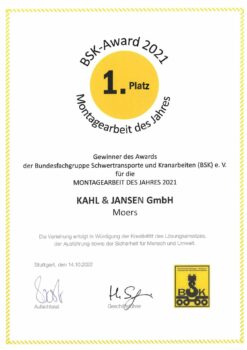
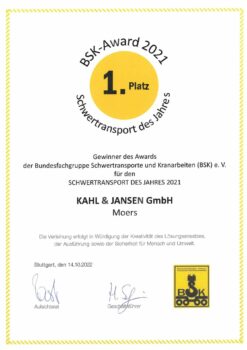
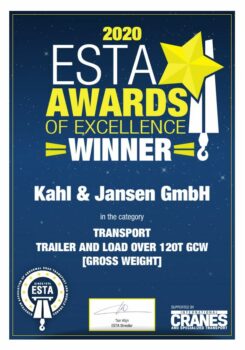
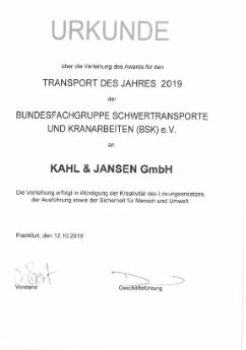
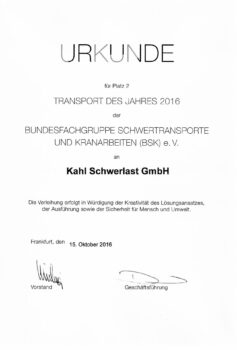
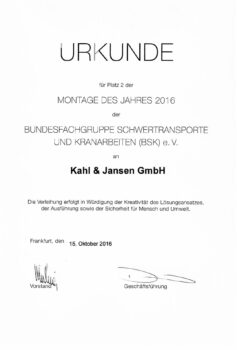
AWARDS
50.000 sqm
FREE STORAGE
22.000 sqm
WAREHOUSES
8
LOCATIONS
PHILOSOPHY
Driven by the values of competence, reliability, trust and honesty, we seek a far-sighted and sustainable implementation of their transport tasks for our customers.
This is done independently of our own equipment, but with the objective of permanent further development in order to guarantee the optimal solution approach in both horizontal and vertical transport.
TEAM
Teaming up for best performance
The implementation of versatile ideas for the individual transport solution or service is in the hands of our experts. Team spirit is just as important as a good education and further training. Experience, the will to perform and profound knowledge are prerequisites for performing the demanding logistic tasks in a reliable manner. An uninterrupted chain of communication both internally and with our customers ensures high quality of all procedures agreed and thus the success of all parties involved.
We also set great store on recruiting and educating young talents. Every year we provide vocational training for Forwarding Merchants and Shipping Clerks as well as Commercial Drivers and Mechatronics Technicians.
For the purpose of a full service we satisfy the customers‘ needs hand in hand.
Customer satisfaction is out motivation.
QUALITY
“Quality begins by placing customer satisfaction in the centre of our thinking.” — John F. Akers
Nothing is more important to us than the trust and satisfaction of our customers and employees.
This is why we introduced a comprehensive quality system several years ago which led to the development of highest quality, safety and environmental standards.
The defined standards are constantly improved and apply to our staff and all associated companies, business partners and service providers alike.
Based on our comprehensive quality system that is certified by external auditors at regular intervals we provide reliable services you can build on.
AWARDS
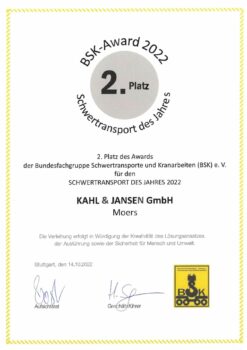
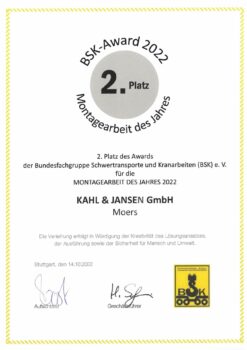
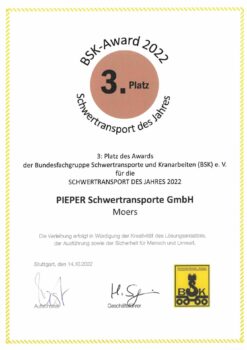
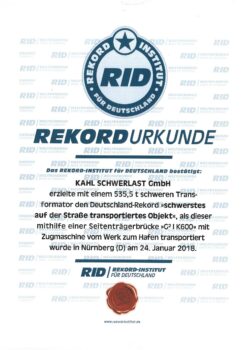
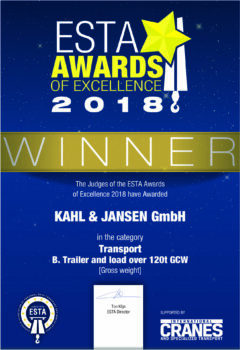
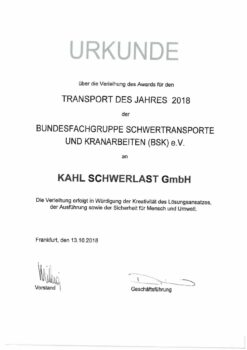
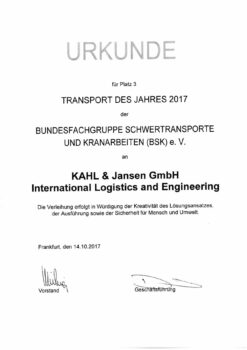
Extraordinary achievements only succeed if a well-rehearsed team pulls together and can rely on one another. Only then can transports of a very special kind be realized. Transports that stand for teamwork, precision, innovation and know-how.
At this point again a big thank you to all employees, who make these projects possible by their tireless efforts.





ASSOCIATION
Only the interplay of all measures and participants creates real impact in logistics – the more integrated, the stronger.
That is why we have been involved for several years in specialist committees and associations that are committed to the interests and affairs of the industry.

HISTORY
FROM HORSE-DRAWN TRANSPORT TO AN INTERNATIONAL HEAVY HAULAGE SPECIALIST
THE EVOLUTION OF THE KAHL GROUP – MORE THAN 120 YEARS OF EXPERIENCE
A TRANSPORT HISTORY SHAPED BY IMPROVISATION, INNOVATION AND ENTREPRENEURIAL SPIRIT
Heavy haulage is a business that rarely speaks for itself through grand words. What people usually see are the results: a transformer travelling by road, a turbine on its way to the port, a bridge section being transshipped, or a wind turbine blade completing its final mile. What often remains unseen is the level of engineering, experience, planning and adaptability required to make such projects possible.
It is precisely at this intersection that the story of the KAHL Group begins. It is not only the evolution of a family-owned company, but also a chapter in the history of German heavy haulage and oversized transport—from the early days of horse-drawn wagons and improvised post-war solutions to today’s multimodal project logistics, self-propelled transporters, specialised bridge systems, heavy lifting technology and industrial installation services.
THE ROOTS: TRANSPORT AS A CRAFT OF RECONSTRUCTION
The official history of the company in Duisburg began on 1 January 1953, when Hans and Helmut Kahl established a branch there. Yet the company’s true heritage reaches back much further. The name KAHL has been associated with transportation for far longer than any single founding date might suggest. At the beginning of this journey stood neither high-tech equipment nor sophisticated engineering, but craftsmanship, ingenuity and the determination to restore transport services under the most challenging conditions.
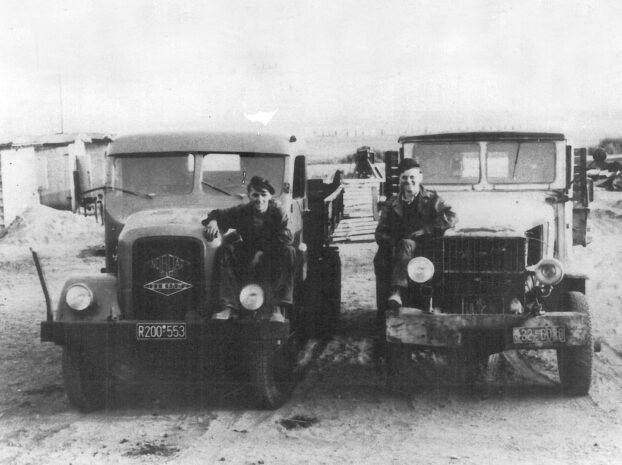
The direct roots of today’s KAHL Group date back to the post-war years. In 1946, the company Konrad Kahl & Sons was founded near Marburg. At a time when vehicles, materials and infrastructure were in short supply, transport solutions had to be created from whatever resources were available. An Opel Blitz powered by a wood-gas generator was one example; later, surplus GMC trucks from the U.S. Army became part of the fleet. Even during this early period, one defining characteristic emerged that continues to shape the company today: technology was never simply accepted as it was—it was adapted, modified and improved. Whenever existing equipment failed to meet operational requirements, it was redesigned. Converting a GMC truck to a Henschel diesel engine was therefore more than a practical modification; it reflected a mindset that would become a defining principle of the company.
With the move to Duisburg and the subsequent establishment of Hans & Helmut Kahl OHG, the company’s focus gradually evolved. What had begun as a traditional haulage business operating tipper trucks, silo vehicles and its first low-loaders steadily developed into a specialist in heavy and oversized transport.
THE PATH INTO HEAVY HAULAGE
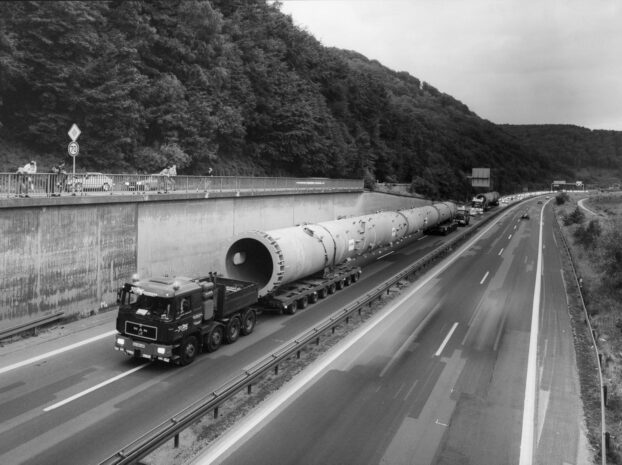
The 1960s and 1970s were defined by rapid industrial growth—and with it, increasing demands on the transport industry. The movement of long structural components, precast concrete elements and loads requiring trailing dollies became increasingly important. At KAHL, the company’s focus likewise shifted steadily towards the transportation of heavier and more complex oversized cargo.
What proved decisive, however, was that this evolution was driven by far more than simply expanding the fleet. It became clear at an early stage that heavy haulage is not merely a question of engine power, but of engineering and system design. How can a load be distributed efficiently? How must a vehicle be modified to perform reliably under real operating conditions? Which combination of tractor unit, trailer, bridge system and auxiliary equipment is required to solve a specific transport challenge? Even in those years, KAHL was more than a transport company—it had already become an engineering-driven problem solver, developing technical solutions for its own operations.
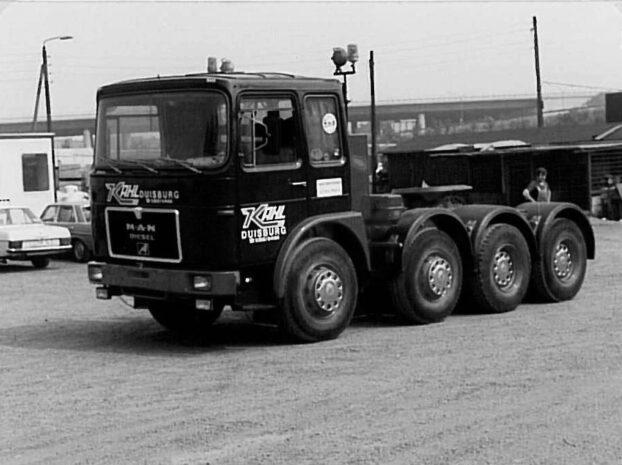
1981: THE FOUR-AXLE TRACTOR AS AN INDUSTRY MILESTONE
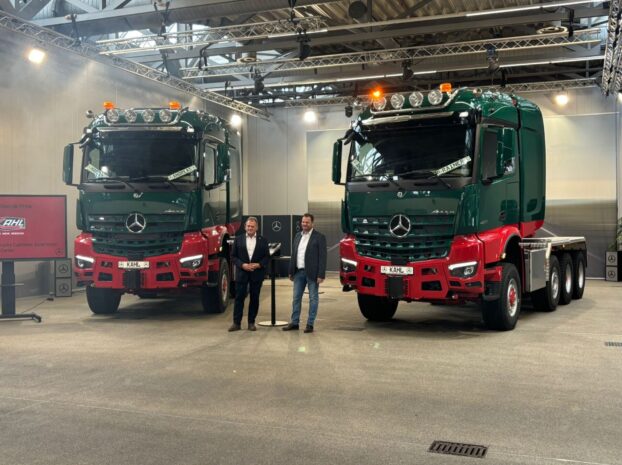
A defining milestone followed in 1981. At a time when three-axle tractor units were increasingly reaching their limits in heavy-duty operations, KAHL developed its first four-axle heavy haulage tractor—based on a concept that would go on to influence the industry for years to come.
The solution did not originate on the drawing board of a major manufacturer; it was born from practical experience in the field. Starting with a three-axle MAN tractor unit, KAHL engineers added an additional steerable front axle in-house. Air tanks, the fuel tank and other technical components were integrated into a custom-built structure behind the driver’s cab. Yet the innovation extended far beyond the additional axle itself. The first four-axle vehicles were assembled by combining components from a variety of manufacturers: a MAN chassis, Mercedes-Benz axles, a 420 hp industrial engine, and custom-designed fuel tanks and auxiliary assemblies were brought together to create a fully functional heavy haulage vehicle. In every sense, it was KAHL vehicle engineering.
Equally remarkable were the conditions under which these vehicles were built. Rather than taking shape in a modern industrial production facility, they were constructed through skilled craftsmanship, ingenuity and extensive improvisation—often working outdoors. It was precisely this pragmatic engineering approach that attracted early attention. The true significance lay not only in the vehicle itself, but in the fact that KAHL had anticipated an engineering concept that would only years later be adopted by major manufacturers and introduced into series production.
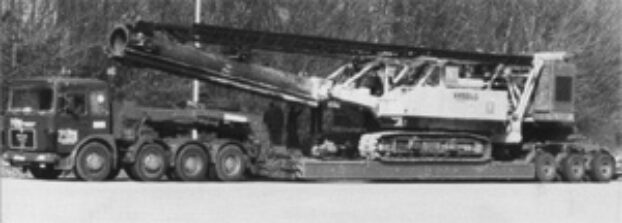
THE FIRST DRIVE-OVER VESSEL BRIDGE COMBINATIONS
Alongside the development of the four-axle tractor, another engineering concept emerged that would become a defining element of the company: the further development of drive-over low-bed trailers and vessel bridge combinations.
The first drive-over vessel bridge combination was essentially created by modifying a six-axle Scheuerle trailer. One side of the running gear was removed and fitted with a Goldhofer gooseneck. Later, the rear section was upgraded with a pin-and-link coupling and Goldhofer THP axle lines. At the same time, vessel bridge combinations equipped with hydraulic goosenecks were further refined, enabling them to be used not only as drawbar trailers but also as fifth-wheel semi-trailers.
This marked a significant step towards more flexible and higher-performance transport systems. Combined with the four-axle tractor unit, the result was not merely an innovative technical configuration, but an entirely new operational concept. Even at this stage, KAHL viewed the tractor unit and the transport equipment not as separate components, but as one integrated functional system. This systems-based engineering approach continues to shape the company’s heavy haulage solutions to this day.
THE TURNING POINT OF 2004: A BREAK RATHER THAN A SMOOTH TRANSITION
As impressive as the company’s technical development was, its entrepreneurial journey was far from straightforward. The events of 2004 marked one of the most significant turning points in the company’s history.
With the crisis and eventual insolvency of Hans & Helmut Kahl OHG, the original parent company ceased to exist. A combination of bad debt losses, declining revenues, an unavoidable major loss event and further economic challenges ultimately led to insolvency. At the same time, the original family branches began to pursue separate paths, making this period far more than a conventional generational transition.
For Andreas and Rainer Kahl, this was not simply a matter of taking over an existing business—it meant starting again. While the KAHL name endured, the company’s economic foundation had to be rebuilt and refinanced almost from scratch. This new beginning involved considerable personal commitment and financial risk. At that stage, the priority was not growth, but securing the company’s future—for its employees as well as for the family itself.
This period explains much about the determination with which the company was rebuilt. Today’s KAHL Group did not simply evolve from its former structure. In many respects, it was created anew.
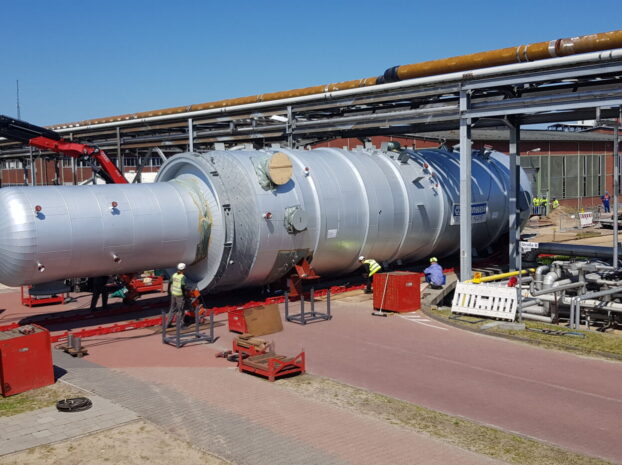
REBUILDING AND STRATEGIC EXPANSION
The establishment of KAHL SCHWERLAST GmbH marked the beginning of a new chapter. In 2005, the generational transition was formally completed, and over the following years the company’s current group structure was built through targeted expansion, strategic partnerships and increasing specialization.
In 2006, KAHL + JANSEN Schwerlast GmbH added further expertise, particularly in the automotive and wind energy sectors. In 2009, Pieper Schwertransporte strengthened the group with additional know-how and extensive international experience. By 2011, the company’s profile had been further expanded through the integration of specialist capabilities in industrial and heavy assembly, transformer handling, loader crane operations and international project management. In the years that followed, additional complementary businesses were incorporated into the group, including a specialist steel construction company.
This development was not the result of organic growth alone, but of a deliberate strategy to build a broadly positioned group of specialist companies. What had once been a traditional heavy haulage company gradually evolved into a provider offering far more than transport equipment and logistics services. Today, the KAHL Group combines a wide range of expertise, enabling it to deliver flexible, integrated solutions for the increasingly complex demands of modern project logistics.
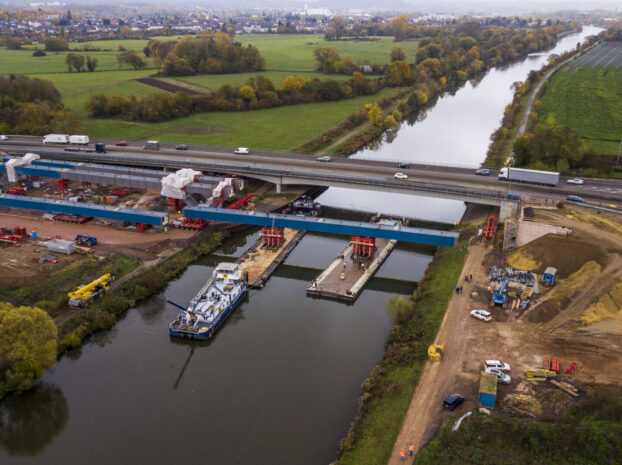
FROM A HAULAGE COMPANY TO AN INTEGRATED HEAVY LOGISTICS PROVIDER
With this transformation, the company’s identity evolved as well. Today, the KAHL Group stands for far more than heavy haulage in the traditional sense. It sees itself as an integrated heavy logistics provider, capable of delivering virtually every key interface within complex project logistics through its own expertise.
Its services begin with route surveys and feasibility studies, extend through engineering and permit management, and include multimodal transport by road, rail and water, with air freight solutions available where required. The portfolio is further complemented by heavy cargo transshipment, port logistics, heavy cargo storage, international project logistics, as well as industrial assembly and engineering services. Additional capabilities include foundation installation, heavy assembly, BF4 escort vehicles, weighing and bridge-crossing systems, trimodal storage and assembly facilities, and a wide range of project-specific engineering solutions.
This breadth of expertise is one of the defining characteristics of the KAHL Group today. It explains why the company is no longer regarded merely as a heavy haulage contractor, but as a provider of comprehensive heavy transport and project logistics solutions.
TECHNOLOGICAL DEVELOPMENT AS A GUIDING PRINCIPLE
Despite all the structural changes, technological innovation has remained a constant pillar of the company’s strategy. The progression from improvised post-war vehicle conversions to the four-axle tractor, and from there to modern bridge systems and self-propelled transporters, is not a narrative created in retrospect—it has consistently been reflected in the company’s practical approach to engineering.
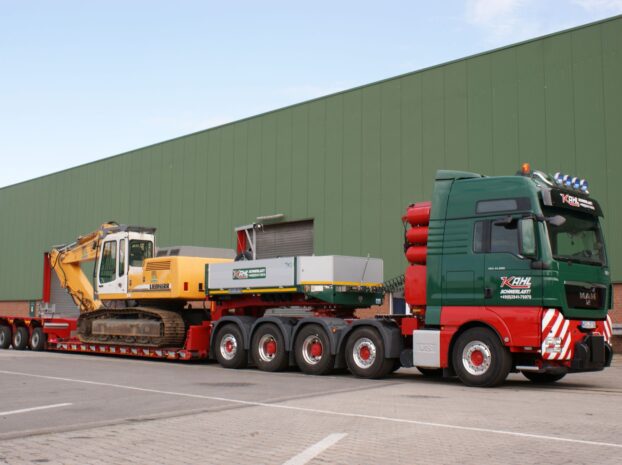
Another important milestone was the introduction of the first new-generation five-axle tractor. At BAUMA 2010, KAHL presented a five-axle tractor based on the MAN TGX 41.680. Designed for a gross vehicle weight of 52 tonnes and a gross combination weight of up to 500 tonnes, the vehicle operated in combination with a specially developed three-axle low-bed trailer, enabling the efficient and cost-effective transport of high loads weighing up to 45 tonnes. Once again, the focus was not on acquiring a single vehicle, but on developing a complete transport concept tailored to a clearly defined operational requirement.
At the same time, the company continued to expand its portfolio of modular axle systems and specialised trailers. Today, the KAHL Group operates a fleet of approximately 150 transport units, around 120 SPMT axle lines and a total of roughly 250 modular axle lines for heavy haulage operations. These capabilities are complemented by extensive logistics infrastructure, including approximately 50,000 square metres of outdoor storage space and around 22,000 square metres of covered facilities. With eight locations, the group maintains a strong national and international presence. Its position within the industry is further reflected by a total of 21 awards and distinctions.
G² | K600: INNOVATION IN THE FACE OF SCEPTICISM
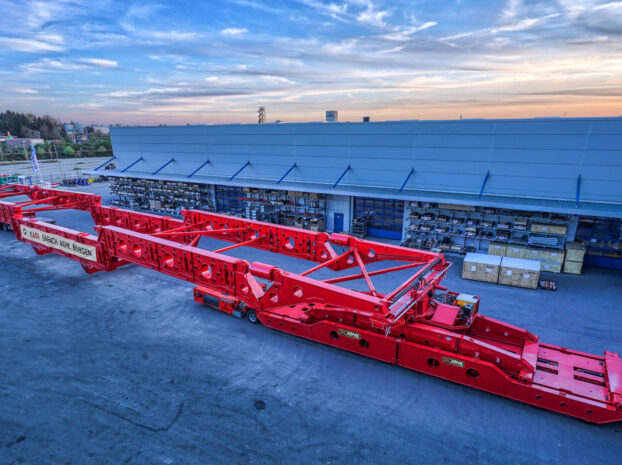
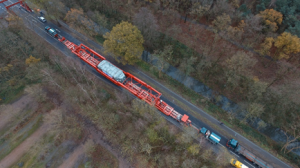
The most significant technological milestone in the company’s recent history was the introduction of the G² | K600 in 2015. Developed jointly with Goldhofer and Greiner, the side girder bridge was delivered after nearly three years of planning and engineering. From the outset, it was designed with a highly specific objective: to enable the reliable transport of extremely heavy loads on the final mile while reducing axle loads to meet increasingly demanding infrastructure requirements.
This was the true innovation behind the G² | K600. It was not simply a larger side girder bridge, but an engineering solution developed in response to a fundamental shift in the requirements of heavy haulage. The challenge was no longer limited to pulling power; it had become a question of how transformers, turbines and other exceptionally heavy components could continue to be transported safely within the constraints of modern infrastructure.
What makes this development particularly remarkable is that it was initiated long before a clear market demand or specific customer orders existed. Initially, no vehicle manufacturer was willing to build such a system. Equally uncertain was whether there would be sufficient transport projects to justify the investment. In fact, when the G² | K600 was finally delivered, the KAHL Group had not yet secured a single transport order for the new system.
This is precisely what makes the project so significant. Its development was driven not by guaranteed demand, but by the conviction that future transport challenges would require fundamentally new engineering solutions. The decision was met with considerable scepticism, and many questioned whether a market for such a system would ever emerge. Nevertheless, the project was pursued with determination and consistency—a clear reflection of the pioneering spirit that has characterised the KAHL Group throughout its history.
PIONEERING THE FUTURE BEFORE THE BIG BRIDGE
The G² | K600 did not emerge in isolation. Several years earlier, KAHL had already commissioned the development of specialised low-bed trailer solutions capable of transporting components weighing up to approximately 200 tonnes while maintaining reduced axle loads. The driving force behind these developments was a series of real-world transport challenges in which existing equipment had reached its technical limits—for example, the transport of an industrial component weighing around 160 tonnes, for which no suitable low-bed trailer with a sufficiently reinforced load-bearing structure was available.
Once again, the solution was developed because it was needed. The successful operation of a rigid low-bed trailer combination measuring approximately 40 metres in length—even on demanding transport routes—provided practical proof that large-scale side girder bridge systems could also be feasible under real operating conditions. This line of engineering thinking ultimately formed an important foundation for the later development of the G² | K600.
PROOF IN PRACTICE
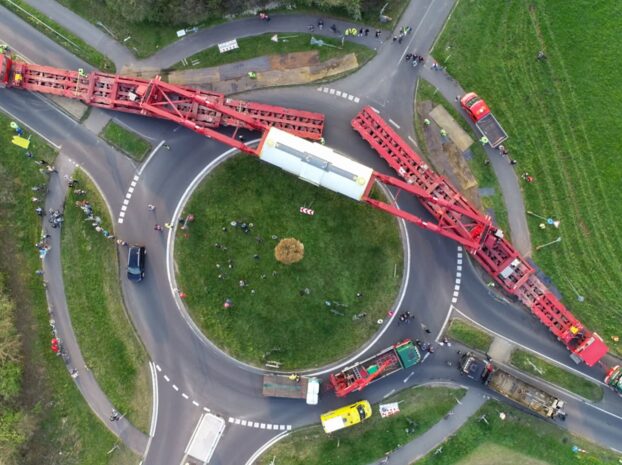
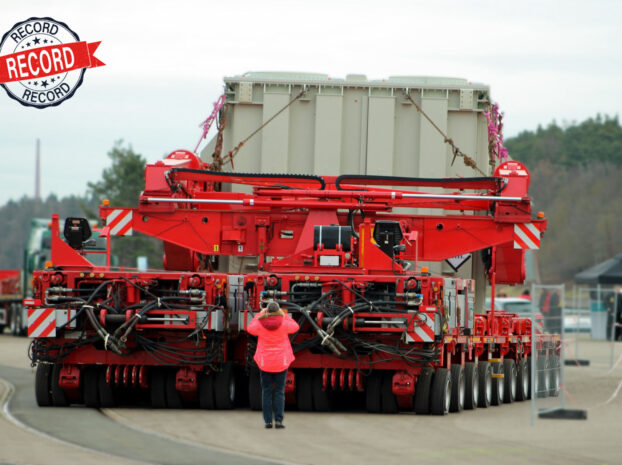
The significance of this technological development became evident in the years that followed. One of its most remarkable achievements was the transport of a transformer with a total transport weight of 875 tonnes using the G² | K600 side girder bridge. The complete transport combination measured approximately 63 metres in length, 7.45 metres in width and 6.10 metres in height. The cargo itself was the world’s most powerful transformer at that time.
The technical and organisational execution of this project made it one of the most outstanding heavy haulage operations of its kind. The Record Institute for Germany (Rekord-Institut für Deutschland) recognised the achievement with the title of “Heaviest Object Ever Transported on Public Roads.” More important than the award itself, however, was what the project confirmed from an engineering perspective: reducing axle loads and distributing extremely heavy loads intelligently would become a defining requirement for the next generation of heavy haulage projects.
MULTIMODAL LOGISTICS, TRANSSHIPMENT AND INFRASTRUCTURE
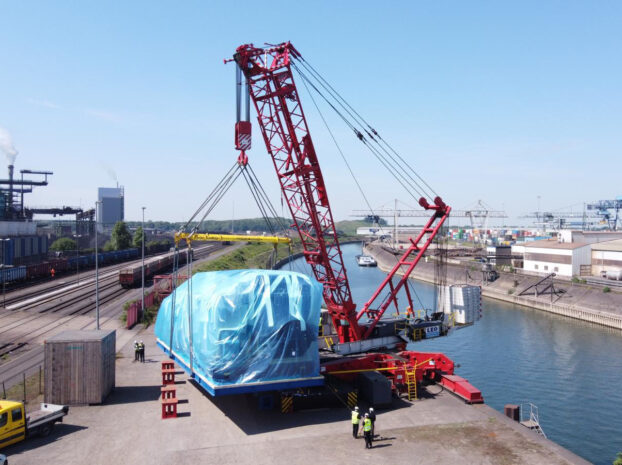
Alongside its technological advancements, the KAHL Group has continuously expanded its infrastructure. Since 2010, the company has been a shareholder in the Duisburg Heavy Cargo Terminal together with strategic partners. With direct access to road, rail and inland waterways, the terminal provides integrated facilities for storage, packaging, assembly and heavy cargo transshipment, ensuring efficient handling with minimal transfer distances. Since 2019, the stationary heavy-lift crane “LEO” has further enhanced these capabilities. In addition, strategic partnerships—including those in the Dresden region—have expanded the group’s multimodal services in transport, storage, transshipment and packaging.
This development clearly illustrates that modern heavy logistics is no longer determined by road transport alone. Especially for transformers, bridge sections, turbines and other oversized industrial components, the ability to plan and execute projects across multiple transport modes has become an essential prerequisite for efficient and economically viable project logistics.
ENERGY, BRIDGES AND WIND ENERGY
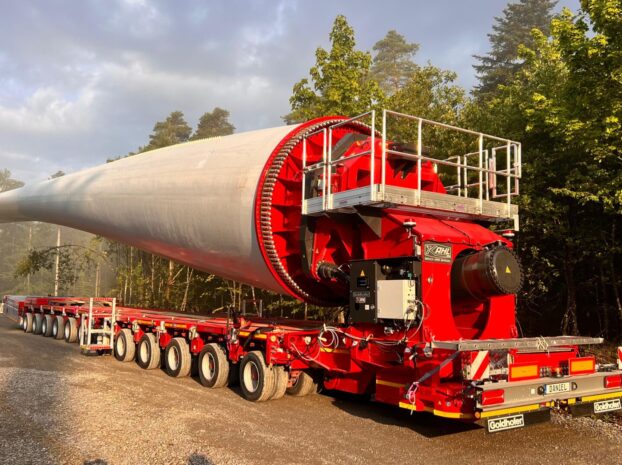
A key focus of the KAHL Group today lies in sectors closely connected with energy infrastructure and industrial transformation. This includes, in particular, the transportation of transformers, encompassing specialised services such as transshipment, installation and, where required, decommissioning and disposal logistics. The transport of bridge sections and complete bridge structures has also been one of the company’s most demanding core activities for many years.
Another major area of expertise is the wind energy sector. Over many years, the KAHL Group has managed and executed the logistics for the construction of wind farms, continuously expanding its capabilities in this field. As other industries have experienced economic slowdowns, wind energy has become an increasingly important part of the company’s transport portfolio. This development has been supported by further investments in specialised trailer combinations for rotor blades and tower sections, as well as the continuous expansion of purpose-built transport equipment for the latest generation of wind turbine components.
INNOVATION DOES NOT END WITH THE VEHICLE
An often overlooked, yet essential, aspect of the company’s development lies in its project-specific engineering solutions that complement heavy transport operations. The company’s own workshop is far more than a maintenance facility—it designs and manufactures custom load-handling equipment, ballast platforms and vehicle modifications tailored to individual projects and delivered within short timeframes. Additional solutions include transport frames for sensitive large-scale gearboxes, weather-protected transport systems for critical components, and a wide range of auxiliary equipment that often proves decisive to the success of a project.
In heavy haulage, a significant share of true innovation is found not in the headline transport vehicle itself, but in the supporting systems that make safe load protection, weight distribution, transshipment, handling and installation possible in the first place. It is here that the KAHL Group continues the long-standing tradition of developing its own practical engineering solutions to meet complex transport challenges.
HEAVY ASSEMBLY AND FURTHER EXPANSION
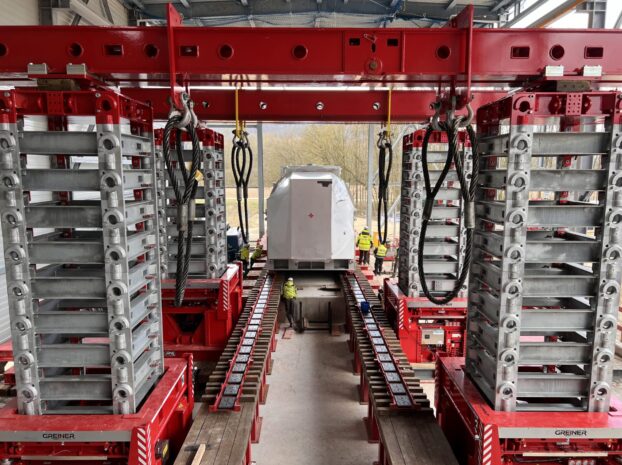
The expansion of the jack-up system since 2023 has further strengthened the group’s capabilities. Consisting of four individually positionable towers—with the option to expand to eight—the system provides a total lifting capacity of up to 4,000 tonnes. In 2022, the company also invested in 38 axle lines of the new FT Series. These capabilities are complemented by hydraulic skidding systems, lifting gantries and additional equipment for heavy assembly and industrial installation.
This development clearly demonstrates that the KAHL Group has evolved far beyond the scope of traditional road transport. Tractor units, modular axle lines, bridge systems, lifting technology, assembly equipment and skidding solutions now work together as integrated engineering systems. Heavy haulage and heavy assembly have increasingly merged into a comprehensive project capability, enabling the group to deliver complete solutions for complex industrial and infrastructure projects.
PERSONAL COMMITMENT TO THE INDUSTRY
An important aspect of the company’s recent history is also Andreas Kahl’s voluntary commitment to the heavy haulage industry. It reflects an understanding of heavy transport that extends well beyond the company’s own projects. Through his work in industry associations, specialist presentations and discussions on technical, infrastructural and regulatory issues, he contributes practical experience from day-to-day heavy haulage operations to the broader industry dialogue.
His work focuses on topics such as permit procedures, infrastructure capacity, the integration of different transport modes, and the conditions required to ensure that oversized and heavy haulage operations, as well as heavy lifting projects, can continue to be carried out safely and reliably in the future. This commitment should not be seen as an extension of the KAHL Group’s business activities, but rather as Andreas Kahl’s personal contribution to the technical and political development of the heavy haulage industry.
CONCLUSION: THE COMMON THREAD THROUGHOUT THIS STORY
The history of the KAHL Group is not a straightforward success story. It is a story shaped by pioneering spirit, engineering ingenuity, a profound entrepreneurial turning point and a determined new beginning. It demonstrates that heavy haulage is not defined solely by vehicles, payloads and transport routes, but by decisions—both technical and entrepreneurial.
The common thread running throughout this history is a simple principle: whenever existing technology or established structures reached their limits, the company did not wait for someone else to provide the answer—it developed its own. From horse-drawn transport to the first four-axle heavy haulage tractor, from the early drive-over bridge combinations and the pioneering five-axle tractor to the G² | K600, multimodal logistics solutions and heavy assembly, this principle has consistently guided the company’s evolution.
This is what makes the history of the KAHL Group more than the story of a single company. It is also a remarkable chapter in the evolution of heavy haulage engineering and project logistics in Germany.
HISTORY – MILESTONES
2023
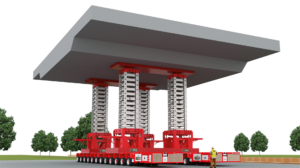
Since 2023, our range of services has been expanded by an innovative jack- up system. The system consists of four individually positionable towers that can be extended by another four towers, thus offering a total lifting capacity of 4,000 tonnes.
2023
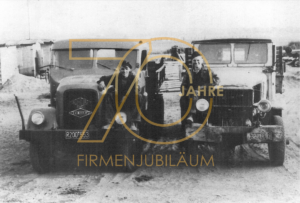
The experts in the field of special, large-volume and heavy transport for 70 years. On 01.01.1953 Hans and Helmut Kahl laid the foundation stone for the successful company history.
2022
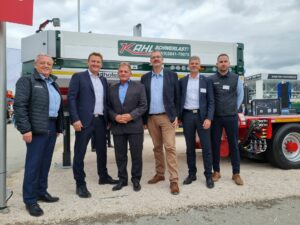
Investment in 38 axle lines of the new “FT SERIES” modular series from Goldhofer AG, Memmingen.
2019
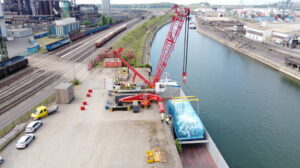
Since 2019, the Duisburg Heavy Lift Terminal (HTD) has been supplemented by our stationary heavy lift crane “LEO” with a handling capacity of up to 300 tonnes.
2017
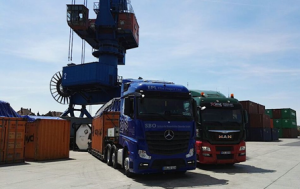
Cooperation of opportunities.
The KAHL GROUP and the Sächsische Binnenhäfen Oberelbe GmbH (SBO) are multimodal logistics companies with a wide range of services. Since 01.06.2017, a cooperation has existed between the two groups of companies to bundle the competences and link the service offers. Through this cooperation, further diverse complete solutions for transport, storage, handling and packaging can be offered.
2016
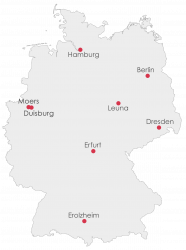
Expanding our presence by establishing new branches across Germany. Since 2016, we have been further expanding our sales network and have established branches in Erfurt, Magdeburg, Dresden, St. Ingbert and Memmingen. With this step, we continue to focus on customer proximity and the highest quality.
2015
From vision to idea and from idea to implementation.
In spring 2015, the time had finally come. After almost 3 years of planning and implementation, we finally took delivery of our G² | K600 side girder bridge, which we developed together with Goldhofer and Greiner, in Memmingen in May 2015. It is unique worldwide and has a payload of 600 t.
2011

The KAHL Group is guided by a common philosophy and values such as
Competence, Reliability, Trust and Honesty.
In the network of owner-operated companies that builds on a highly efficient and committed team we can…
SIMPLY MOVE MORE.
2011
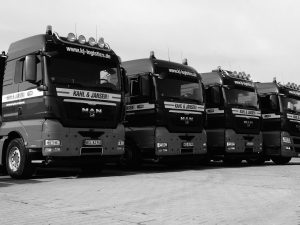
Services from a single source. The KAHL & JANSEN GmbH extends the service portfolio of the KAHL Group by its know-how in the area of transformer handling, industrial gas tank logistics and installation as well as international project management.
2010
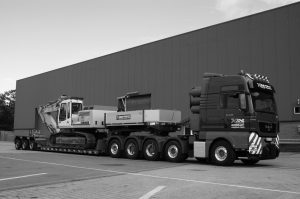
Initially presented at the BAUMA 2010: The first 5-axle truck based on MAN TGX 41.680 with a gross weight of 52 tonnes and a gross haulage weight of 500 tonnes. Together with the 3-axle drop deck developed for this purpose the new vehicle concept saves cost and time when it comes to hauling goods of up to 45 tonnes loading weight.
2010
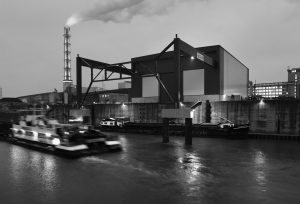
Together with our partners we have been running the heavylift terminal (HTD) at the Duisburg port since 2010. By being connected to road, rail and water we provide heavy-duty logistics par excellence:
Storage, packing, installation and heavy goods handling at short distances under optimal conditions.
2009
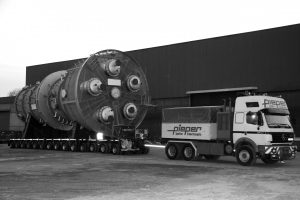
Since 2009, Marcus Pieper has complemented the know-how and the technical possibilities of the KAHL GROUP with Pieper Schwertransporte GmbH.
2006
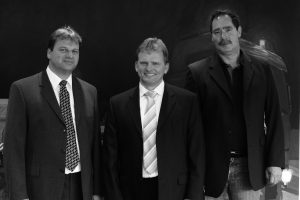
With the logistics specialist Ferdinand Jansen and the foundation of KAHL + JANSEN Schwerlast GmbH the business activities were extended by new customers and special transport facilities for the automotive industry and wind turbine manufacturers.
2004
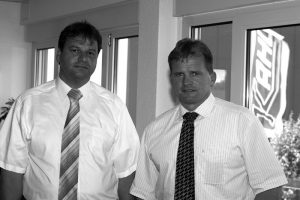
Building on 50 years of experience the management was taken over by the current owners and Managing Directors Andreas and Rainer Kahl and the KAHL SCHWERLAST GmbH Internationale SchwertransportLogistik founded.
1998
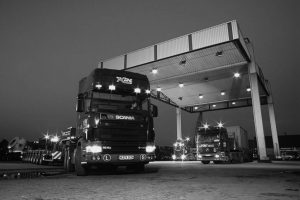
The relocation from Duisburg to Moers was the stepping stone for a considerable expansion of the business activities. Today storage, shipment, packing and handling of extremely heavy goods are integral part of our service offerings.
1990er
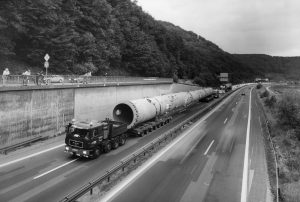
What began in the 1980ies was continued systematically in 1990ies by adding modular bogies and more combination options to the existing equipment.
1980
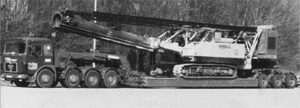
The overridable drop/ vessel deck combination with removable, hydraulic gooseneck was commissioned as early as in the 1980ies as part of our own transport fleet. It still forms the basis of modern low loader combinations.
1981
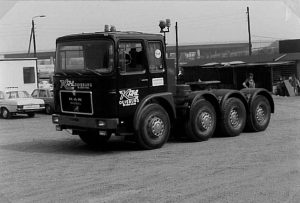
A milestone in the development of today’s heavy-duty trucks and example of the creativity of the KAHL company is the construction of the world’s first 4-axle semi-trailer truck.
1970er
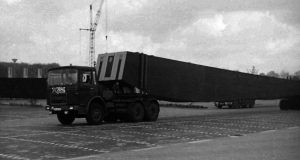
In the 1970ies of the last century our fleet covered over 30 self-steering trailer trucks for long loads. At that time the focus of activities was on the transport of precast concrete parts of all kinds.
1960er
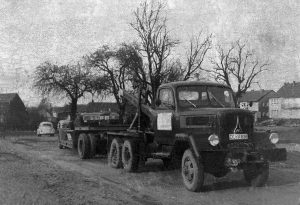
As early as in the 1960ies we engaged in low loader transports. The converted GMC Motorwagen (1942 model) with a crane superstructure and low loader is ready to go at the premises in Duisburg, Frundsbergstrasse.
1953

The brothers Hans and Helmut (23 and 17) set up a branch of Konrad Kahl & Söhne in Duisburg (with two converted GMC vehicles from the US army). In 1956 it became the Hans u. Helmut Kahl oHG.